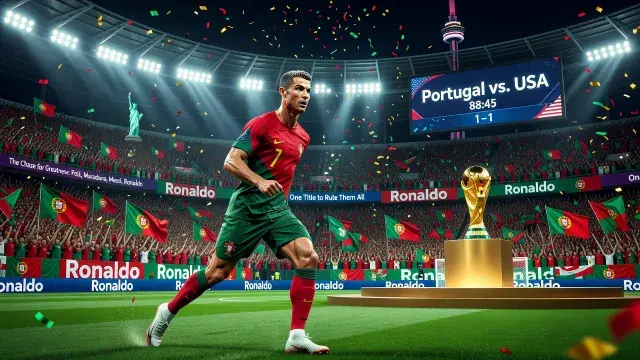
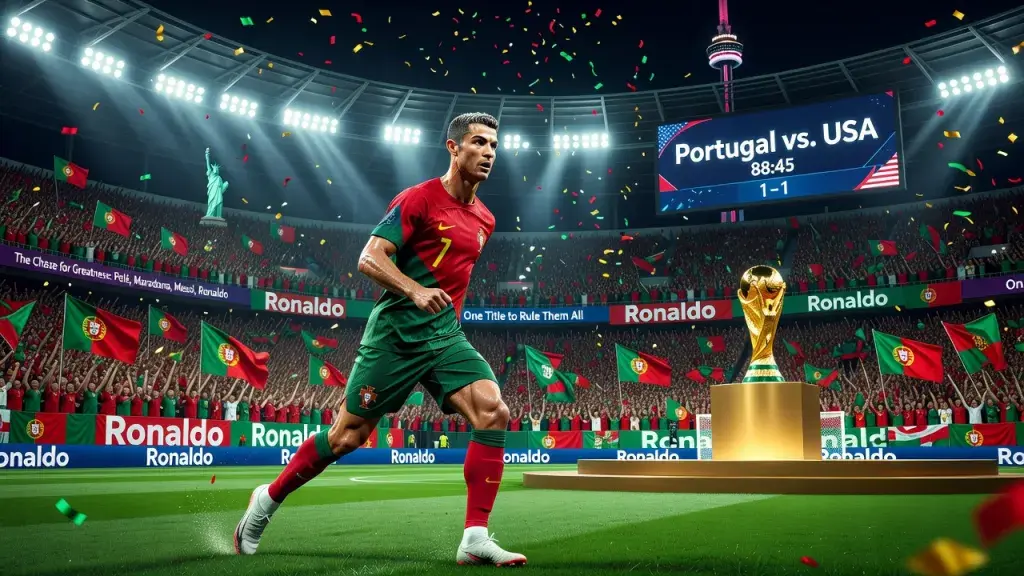
As the 2026 Fifa World Cup takes hold of the global sporting calendar across North America, one question dominates the conversation above all others: does Cristiano Ronaldo need to lift the trophy on July 19 to be considered a true all-time great? At 41 years old, the Portugal captain arrives at what is almost certainly his final World Cup carrying the weight of an extraordinary career and one conspicuous absence on his trophy shelf. The stakes, personally and historically, could not be higher.
The debate splits supporters right down the middle, and it has done for years. Traditionalists hold firm to the belief that the World Cup is the non-negotiable entry ticket to football immortality - the exclusive club of Pelé, Diego Maradona, and Lionel Messi. Critics applied the same logic to Messi for over a decade, until his fairytale triumph in Qatar four years ago answered them definitively. Now that pressure falls entirely on Ronaldo's shoulders, in a tournament that commands attention far beyond football, from the Brasileirao faithful in Rio to Premier League fans in Lagos and the growing football community across India. Much like how niche sporting events such as the tt cup poland attract dedicated followers who understand that greatness is measured differently across disciplines and contexts, the Ronaldo debate asks us to consider whether one competition can define an entire sporting life.
The case for Ronaldo needing no World Cup medal to validate his greatness is, frankly, overwhelming. He is the highest goalscorer in football history. He has won five Uefa Champions League titles - a competition that demands consistent excellence across nine months and multiple knockout ties against elite opposition, making it a far more gruelling test than a single month-long tournament. He dismantled records in three of Europe's most demanding leagues: the Premier League with Manchester United, La Liga with Real Madrid, and Serie A with Juventus. Five Ballon d'Or awards sit alongside those league titles. Excluding a player of that profile from the greatest-of-all-time conversation on the basis of one missing trophy is an argument built on sentiment, not sporting logic.
Built Portugal From the Ground Up
There is a context to Ronaldo's international journey that his critics consistently undervalue. Messi inherited Argentina, a nation steeped in World Cup mythology. Pelé played for Brazil, football's most successful international programme. Ronaldo was born into a Portugal side that had qualified for just one of the four World Cups immediately preceding his international career. He did not inherit a winning machine. He helped construct one, often carrying an entire footballing nation on his back for two decades.
His international record reflects that burden and that brilliance in equal measure. He led Portugal to their first-ever major international trophy at Euro 2016. He guided them to Nations League glory in 2019. He has scored more international goals than any player in the history of the game. These are not consolation prizes; they are landmark achievements that would define most careers entirely on their own.
The Weight of World Cup History
The counter-argument carries its own undeniable force, and it deserves honest acknowledgement. The World Cup operates on a different emotional and cultural frequency to any other competition in sport. Pelé's emergence as a teenager in 1958, Maradona's defiant one-man assault on England and West Germany in 1986, Messi's slow-burning, almost anguished march through Qatar - these are not merely sporting results. They are cultural moments etched permanently into the collective memory of billions of people. No spreadsheet captures them.
Critics will also point to a specific statistical gap: Ronaldo has not scored in a World Cup knockout match. On a résumé otherwise close to flawless, it is a genuine anomaly. But judging a 20-year career defined by relentless consistency against the standard of a handful of elimination fixtures every four years is a reductive framework that modern football analysis has largely moved beyond.
A Legacy Already Secured, Whatever Happens Next
If Portugal are eliminated in North America, the critics will reopen every old file and argue that Ronaldo sits a permanent step below the game's true immortals. That verdict, if it arrives, will be wrong. Greatness in football is not administered by a single governing moment. Ronaldo's career - its duration, its relentlessness, its sheer accumulation of goals and trophies across multiple countries and cultures - constitutes its own complete argument.
A World Cup winners' medal would not prove his greatness. That has already been established beyond reasonable dispute over twenty years of elite competition. What it would do is silence the critics once and for all - and almost inevitably ignite an entirely new argument: whether a 41-year-old who conquered the last frontier of international football should be considered not merely a GOAT, but the greatest of them all. Portugal and their captain will carry that possibility into every match in North America. The world, as it always does when Ronaldo is involved, will be watching.