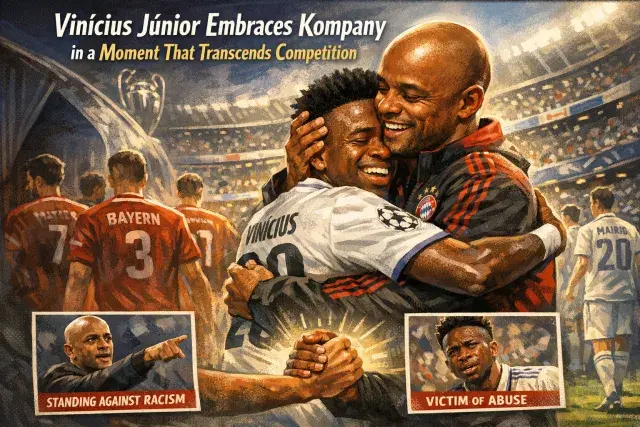
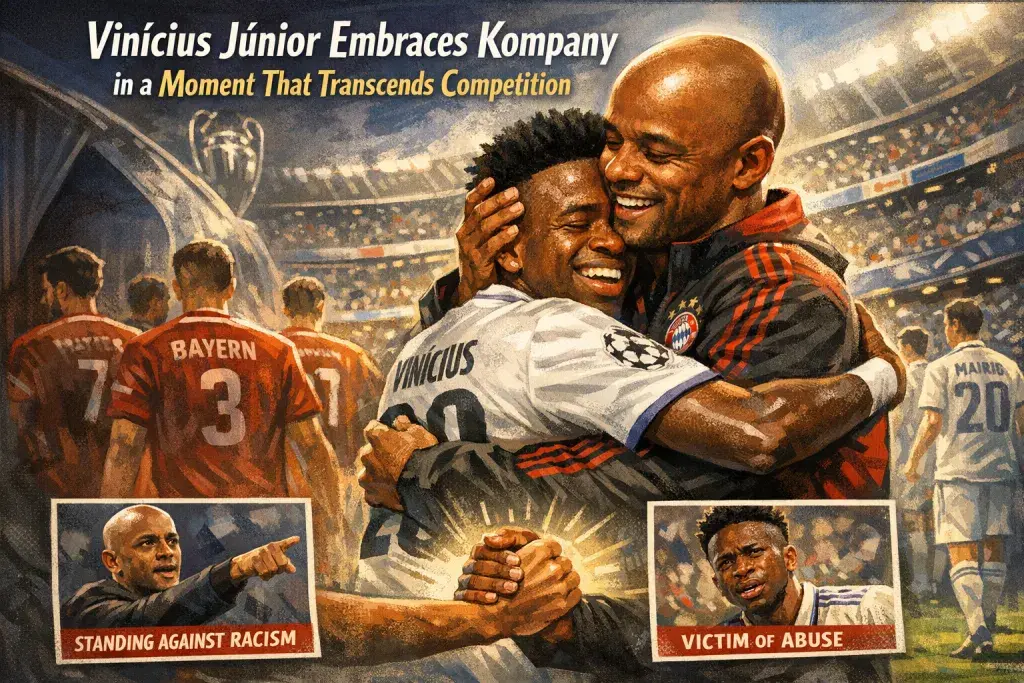
A brief, wordless exchange at halftime of the UEFA Champions League quarter-final between Real Madrid and Bayern Munich carried more weight than the scoreline. As the two sides returned to their respective preparations for the second half, Vinícius Júnior crossed the pitch to find Vincent Kompany, the Bayern Munich head coach, and greeted him with a high five and a hug. It was a personal acknowledgment — not of rivalry, but of solidarity.
The Backstory Behind the Gesture
The moment did not emerge from nowhere. Weeks earlier, Vinícius had publicly accused Gianluca Prestianni, a Benfica forward, of directing racist abuse toward him during a Champions League playoff fixture. The allegation reignited a debate that European football has struggled to resolve — how institutions and individuals within the sport respond when racial discrimination surfaces on the field.
Kompany, who himself spent formative years in European football as a Black player and later as a figure of significant cultural standing in the game, responded publicly with unequivocal condemnation. His statement stood out not simply for its content but for its clarity and timing — issued when the incident was still raw and contested. He did not hedge, did not offer the standard diplomatic language that too often follows such accusations, and did not wait for an institutional verdict before taking a position.
That kind of public stance carries risk. Individuals in prominent managerial roles often choose neutrality to protect professional relationships and avoid controversy. Kompany chose otherwise, and Vinícius evidently did not forget it.
Why Public Solidarity on Racism Still Matters
It would be easy to reduce this moment to a feel-good footnote. That reading would miss the point. Racism in European football has been documented, condemned, and insufficiently addressed for decades. Governing bodies have issued bans, clubs have published statements, and campaigns have launched — yet incidents continue with discouraging regularity. What tends to be underreported is the social cost borne by those targeted: the fatigue of repeated exposure, the institutional pressure to stay quiet, and the isolation that comes when powerful peers decline to speak.
When someone in Kompany's position — a recently appointed head coach at one of Europe's most prominent clubs — publicly defends a rival's player against racist abuse, it shifts the dynamics. It communicates that silence is not inevitable, that support is possible across institutional lines, and that personal integrity can outweigh institutional caution. The value of this is not symbolic. It is structural. Norms in professional environments are shaped by visible behaviour from those with authority, and Kompany's response modelled something worth noting.
A First Meeting, A Lasting Impression
After the fixture concluded, Kompany addressed the halftime encounter directly, confirming it was the first time he and Vinícius had met in person. His remarks were measured but warm. He expressed admiration for the Brazilian winger's personality, suggesting that football — and by extension, any high-pressure, high-visibility profession — needs individuals willing to be distinctly themselves, even when that draws criticism. He also restated a position he had made clear earlier: that criticism of public figures, however robust, must never be allowed to cross into abuse rooted in identity.
That distinction — between legitimate criticism and discriminatory targeting — is one that institutions frequently blur in their handling of such cases. Framing racism allegations as contentious or subjective, rather than as a specific category of harm with specific consequences, has been a recurring failure in how European football's governing bodies respond. Kompany's articulation of that line, in clear terms and without qualification, contributed to a more honest public framing of the issue.
Mutual Respect as a Counter-Narrative
The image of Vinícius and Kompany embracing — two Black men, one a global figure of enormous visibility and the other a respected authority within the institutional structure of European football — offered a counter-narrative to the hostility and indifference that racism incidents so often generate. It did not resolve anything structurally. Prestianni's case remains subject to official processes. The broader problem of racial abuse persists.
But the moment demonstrated something that formal processes rarely produce: that personal acknowledgment of harm, and solidarity across competitive lines, remain acts with genuine meaning. In an environment where professional relationships are carefully managed and public gestures are often calculated for image rather than substance, a hug offered and received without ceremony communicates something that press releases cannot.